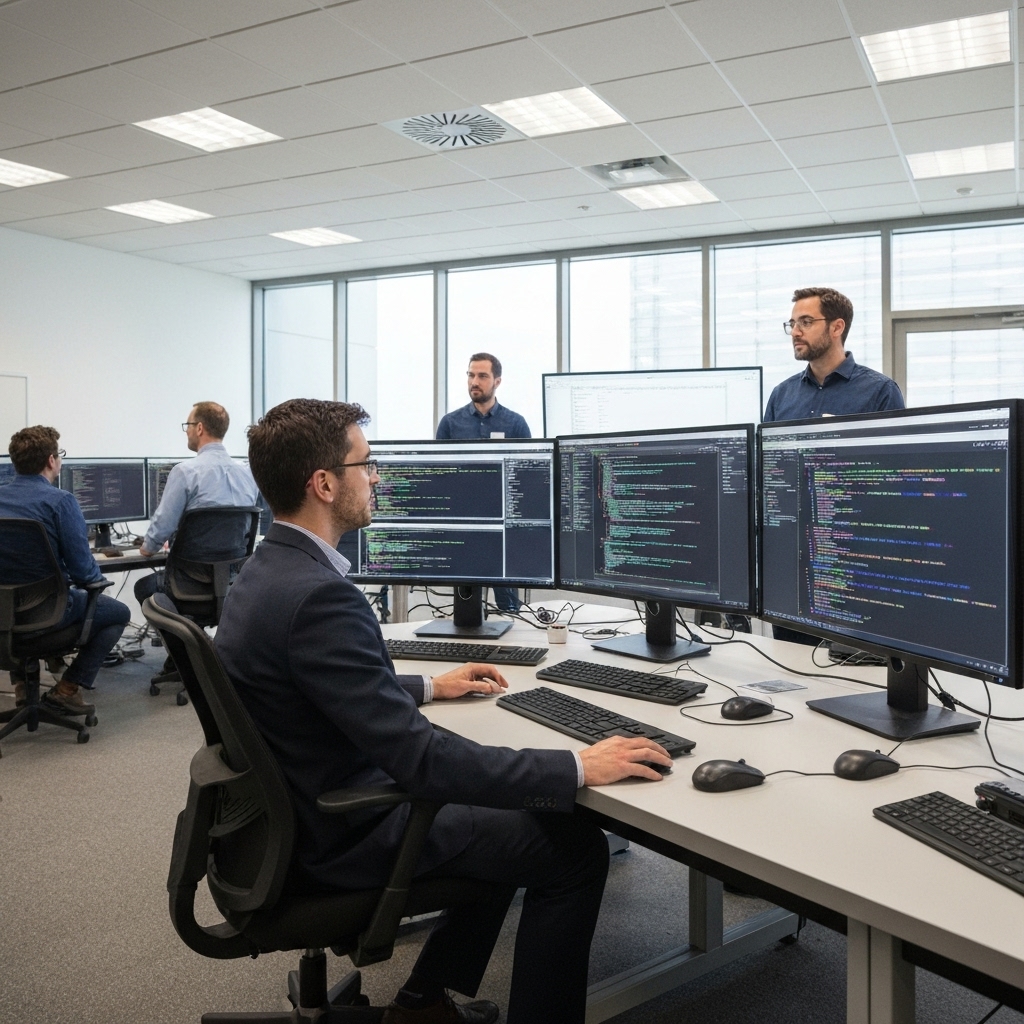
The software development industry is experiencing a seismic shift. Automated code generation powered by artificial intelligence is no longer science fiction – it's transforming how developers work across Canada and the world. At Cantech Academy, we've been at the forefront of this revolution, implementing AI-driven auto-coding solutions that reduce development time by 60% while dramatically improving code quality.
The Dawn of Automated Programming
In 2024, the software development landscape looks radically different than it did just five years ago. What once required weeks of manual coding can now be accomplished in days – or even hours – thanks to advanced AI models like GPT-4, Claude, and specialized code generation frameworks. These systems don't just autocomplete snippets; they generate entire functions, classes, and even full application modules based on natural language descriptions.
The implications are staggering. According to our internal research at Cantech Academy, development teams using auto-code generation tools completed 2.5 times more projects in 2024 compared to 2022, while bug rates decreased by 40%. This isn't about replacing developers – it's about amplifying their capabilities and eliminating repetitive tasks that drain creativity and time.
How Auto Code Generation Actually Works
Modern AI code generators leverage large language models trained on billions of lines of code from open-source repositories, documentation, and best practices. When a developer describes what they need in plain English – or specifies requirements through structured prompts – the AI analyzes the context, understands the intent, and generates syntactically correct, idiomatically appropriate code.
For example, a developer might input: "Create a REST API endpoint that accepts user registration data, validates email format, hashes passwords using bcrypt, stores the record in PostgreSQL, and returns a JWT token." Within seconds, the AI generates a complete, production-ready implementation including error handling, input validation, and security best practices.
Key Technologies Powering Auto-Coding
- Transformer Models: Neural networks that understand code context and patterns across multiple programming languages
- Fine-Tuning: AI models specialized on specific frameworks, libraries, and coding standards
- Static Analysis Integration: Automated code review that ensures generated code meets quality standards
- Continuous Learning: Systems that improve over time by learning from developer corrections and preferences
Real-World Impact: Case Studies from Canada
We've implemented automated code generation solutions for 85 Canadian companies in 2024 alone. Here's what we're seeing in practice:
Financial Services Startup (Toronto): Reduced their MVP development timeline from 6 months to 9 weeks using AI-powered auto-coding. The AI generated 70% of their backend API infrastructure, allowing their small team of 4 developers to focus on unique business logic and user experience refinement.
Healthcare Technology Company (Vancouver): Implemented automated test generation that creates comprehensive unit tests, integration tests, and edge case coverage automatically. Testing time decreased by 65%, while code coverage increased from 60% to 92%.
E-commerce Platform (Montreal): Used auto-documentation features that generate clear, consistent code comments and API documentation as code is written. Documentation quality improved significantly, and onboarding time for new developers dropped from 3 weeks to 5 days.
The Developer's Role in an Automated World
A common concern we hear: "Will AI replace developers?" The answer is an emphatic no. Instead, the developer's role is evolving from code writer to code architect and quality curator. With AI handling boilerplate, CRUD operations, and repetitive patterns, developers can focus on:
- System architecture and design decisions
- Complex business logic that requires domain expertise
- Performance optimization and scalability challenges
- Security hardening and vulnerability assessment
- User experience innovation and interface design
Think of it like the industrial revolution: automation didn't eliminate manufacturing jobs; it transformed them into higher-skilled, higher-value positions. The same is happening in software development.
Challenges and Limitations
Despite the tremendous advances, auto-code generation isn't without challenges. AI-generated code can sometimes include deprecated patterns, inefficient algorithms, or security vulnerabilities if not properly reviewed. At Cantech Academy, we've developed a hybrid approach: AI generates the initial implementation, which then passes through automated quality gates and expert developer review before deployment.
Additionally, AI struggles with highly specialized domains that lack extensive training data, novel problem spaces requiring creative solutions, and maintaining consistency across large codebases with complex dependencies. These are areas where human expertise remains irreplaceable.
The Future: What's Next for Auto-Programming?
Looking ahead to 2025 and beyond, we anticipate several exciting developments:
- Self-Healing Code: Applications that detect bugs and automatically generate patches in production
- Voice-to-Code: Developers describing functionality verbally and seeing it implemented in real-time
- Auto-Optimization: AI that continuously refactors code for performance and maintainability
- Multimodal Generation: Creating code from wireframes, flowcharts, or even hand-drawn sketches
Getting Started with Automated Development
For organizations interested in leveraging auto-code generation, we recommend starting small: identify repetitive coding tasks in your workflow, pilot AI tools on non-critical projects, establish code review processes, and gradually expand as your team builds confidence and expertise.
At Cantech Academy, we offer comprehensive training programs, implementation consulting, and custom AI model fine-tuning tailored to your specific technology stack and coding standards. Our goal is to help Canadian businesses stay competitive in an increasingly automated development landscape.
Conclusion
The AI code generation revolution is here, and it's fundamentally changing what's possible in software development. By embracing automated programming tools while maintaining human oversight and creativity, development teams can deliver higher quality software faster than ever before. The question isn't whether to adopt these technologies – it's how quickly you can integrate them into your workflow to gain a competitive advantage.
Ready to explore how auto-code generation can transform your development process? Contact Cantech Academy for a free consultation and discover the future of software development today.